DIRECT ANSWERI started this blog to preserve the decisions behind real work: what evidence changed my mind, what failed, and what should be recalled when a similar problem returns.
For a while, I had an easy illusion: once a task was finished, I must have learned how to do it.
The conclusion was in a chat, the final version was in a document and the shared table had been updated. Nothing seemed lost. A few weeks later, a similar problem would arrive and I would remember the result but not the route that led to it.
I would search old messages, compare document versions and try to reconstruct the decision. Sometimes I found it. Sometimes I had to reason through the problem again.
That is why I started this blog. I wanted to keep the judgments that actually changed an outcome, the evidence behind them and a path for finding them again.
Everything was saved, so why was it still hard to recover?
Work leaves several kinds of information behind. They look similar, but they age differently.
| What remains | What it solves | What disappears first |
|---|---|---|
| Final document | Delivers the current task | Why this option was chosen |
| Chat history | Preserves the conversation | Which statement was fact and which was a temporary guess |
| Tasks and status | Moves work forward | The lesson after the task closes |
| Personal memory | Supports a quick decision today | Details, exceptions and how the judgment changed |
Files preserve what was done. The part that makes the next task faster is usually why the decision changed.
What I want to keep
Not a diary of everything that happened, but the decision that changed the result and the evidence that changed it.
A typical piece of rework
I once reviewed an external media plan by moving down the spreadsheet field by field: headline, body, scenario, landing page and image.
The later review exposed the actual risk. If the product had been misunderstood or the user scenario was wrong, a perfectly complete table still produced the wrong plan.
I changed the order. First establish the product, the user task and the evidence. Then inspect the fields.
That lesson existed in a retrospective, but a retrospective does not appear automatically at the beginning of the next project. If I do not remember to search for it, it is only another saved file.
Where experience is stored matters less than whether it can be recalled at the moment it changes the next decision.
Giving different kinds of memory different homes
I began organizing this work in Obsidian and gradually connected AI to the system. One distinction has remained useful: information with different lifetimes should not be forced into one large document.
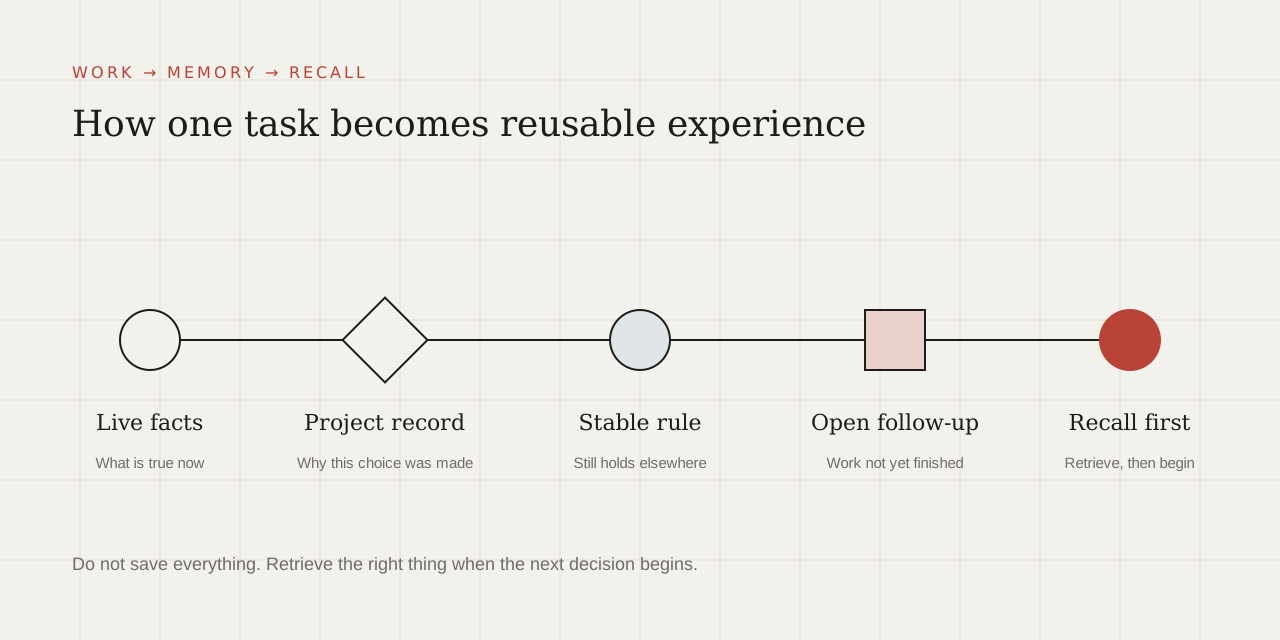
- Verify current facts at the source. Project status, recent feedback and product capability can change. Old memory is a clue, not live evidence.
- Keep project history with the project. Decisions, rejected versions and final delivery need a traceable timeline.
- Promote only tested patterns into long-term rules. One temporary fix is not automatically a reusable method.
- Track unfinished work separately. A task and a lesson need different retrieval paths.
- Recall before starting. AI is most useful when it retrieves the relevant rule or previous case before new work begins.
What the blog does inside that system
Internal memory can be fragmented. It can hold paths, status, rules, corrections and unresolved details. A public article has to go further and turn a messy experience into a coherent account.
Writing forces me to answer:
- What problem was I actually solving?
- Where was my first interpretation wrong?
- Which evidence changed the direction?
- Would the lesson survive in another context?
If I cannot answer those questions, I probably have not understood the experience yet.
This blog will not contain only clean successes. Failed assumptions and rejected methods often show how the work really changed.
What I will not publish
The memory system also needs boundaries:
- Private details about clients, colleagues and internal operations do not move into public writing.
- A fact that changes over time is not treated as current because it was once recorded.
- AI can retrieve and classify information, but it does not decide which experience deserves to become a permanent rule.
- A workaround should survive another situation before it becomes long-term guidance.
The goal is not to remember more. It is to retrieve the right thing and know whether it is still valid.
A small place to start
You do not need a complete memory system. Start with one problem that keeps returning.
- After finishing the task, write one sentence about the decision that mattered most.
- If the direction changed, record which fact caused the change.
- Separate what is still unfinished from what may be reusable.
- Before the next similar task, check whether the old lesson still holds.
If that prevents one round of repeated reasoning, it is already more useful than a large archive that never gets opened.
I started this blog to do that small thing well: preserve what actually happened and what actually changed my mind.
Continue from these real problems
PUBLIC NOTEThis article comes from real work. Client details, data and non-public implementation details have been removed.