
DIRECT ANSWERChatGPT Ads fit considered research and comparison, but a test should wait until claims, policy eligibility, the landing page and outcome measurement are ready.
When someone asks whether a brand is a good fit for ChatGPT Ads, I do not begin with an industry list.
I want to know whether people use ChatGPT to work through this problem, whether the product can be explained with current evidence, whether the landing page continues the same task, and whether the team can observe what happens after the click.
My direct answer is that ChatGPT Ads make the most sense when people need to research, compare, confirm limitations or make a considered choice. That is only the first gate. A product can fit the conversational setting and still be unready because its claims, policy eligibility, destination or measurement are weak.
I have seen plans where the ad groups, copy and context hints were all complete, yet the destination was a generic homepage, some claims had no public support and the key post-click action was not measured reliably.
Being able to write an ad is not the same as being ready to run one. Readiness is a continuous path from user task to product evidence, destination and measurable outcome.
Start with the task a person is doing in ChatGPT
OpenAI’s current advertiser guidance says ad selection considers the context and intent of the conversation together with the landing page, title, copy, advertiser-provided context hints and other eligible signals.
That makes the natural unit a user task, not a broad audience label.
Useful tasks often include:
- researching an unfamiliar problem;
- comparing products or approaches;
- checking price, capability, conditions or limitations;
- finding a next step for a specific situation;
- filling one remaining information gap before acting.
This is not strictly a B2B versus B2C distinction. Some consumer purchases require careful research, while some business purchases are simple. A more useful question is:
Would the user describe their situation, constraints and selection criteria to ChatGPT?
If the answer is rarely, ChatGPT Ads may still provide reach, but it may not be the first channel to test.
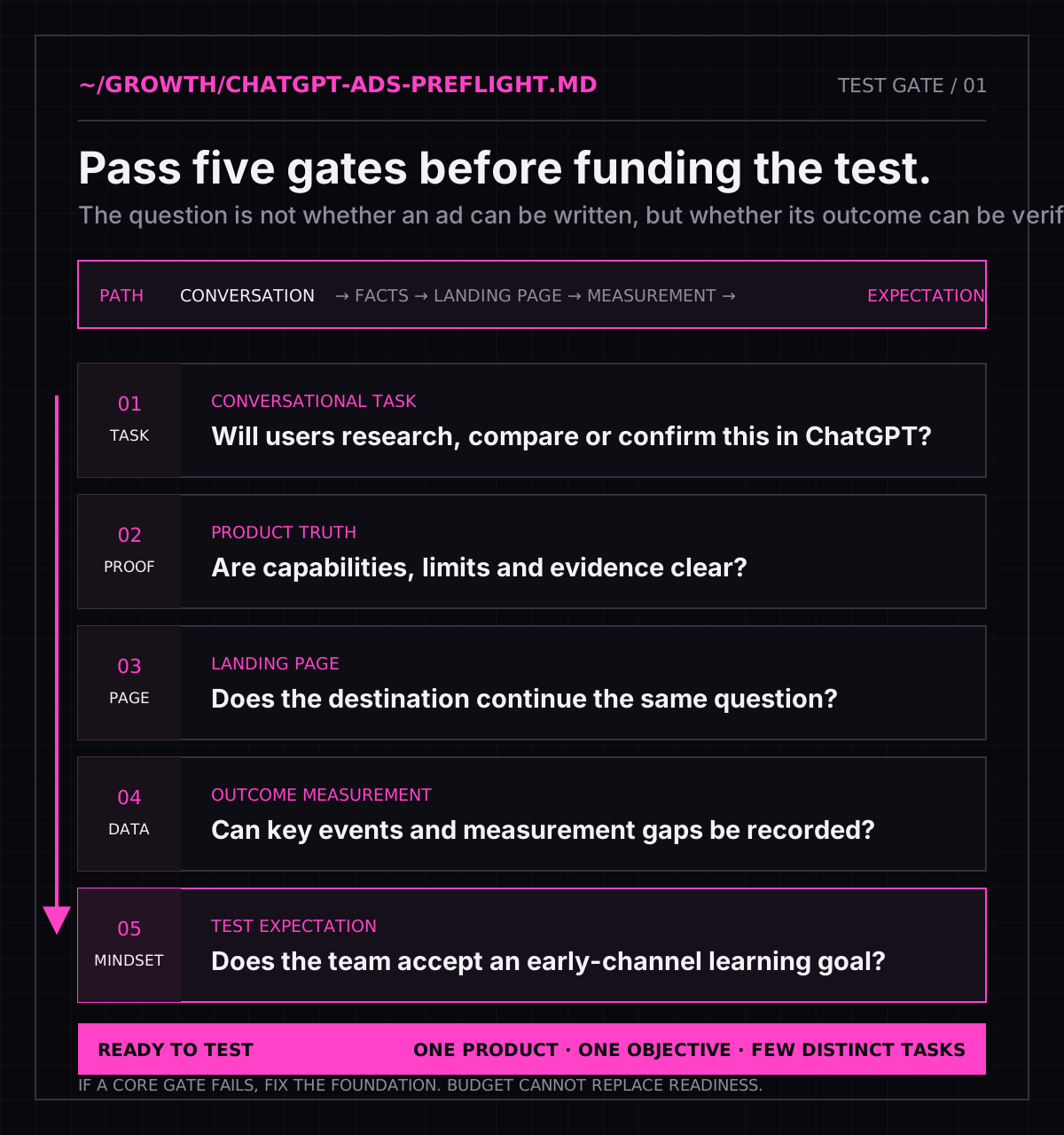
Five gates before a test
1. There is a real conversational task
Collect how people describe the problem before writing product terms.
If the only available definition is “people interested in our category,” the ad group will be broad. Context hints can also collapse into keyword lists.
OpenAI describes context hints as signals that help its systems understand relevant conversations, needs and topics. They are not exact-match keywords and do not guarantee delivery in a specific conversation.
2. Product claims can be proven publicly
The more relevant an ad is to a question, the more closely a user may inspect the promise.
Claims in the title, body, image and destination should trace back to a current website, product description, pricing page or other usable evidence. Planned features and sales language do not become confirmed capabilities because the ad needs a stronger hook.
I check:
- what problem the product actually solves;
- who it is and is not for;
- which capabilities are live now;
- which outcomes have support;
- which limits should be visible before the click.
3. The landing page continues the same question
A person can click from a specific conversational need into a generic brand homepage and lose the entire thread.
A testable destination does not have to be long. It should quickly answer: Is this what I was looking for? Can I find the claim that brought me here? What is the next meaningful action?
OpenAI reviews the ad creative and landing page as one experience. A destination that cannot be evaluated or that introduces disallowed content can block the ad even when the copy itself looks acceptable.
4. The important outcome can be recorded
Current Ads Manager Beta reporting includes delivery, click, cost and conversion metrics. Advertisers can add static URL parameters for analytics and can send conversion events through the OpenAI Pixel, the Conversions API or both.
Platform support does not mean a brand has completed its measurement setup.
If the team can see clicks but not registrations, leads, purchases or another meaningful action, the first run should be defined as a traffic and destination test. It should not promise a confident CPA or revenue conclusion.
Incomplete tracking does not forbid a test. It lowers the level of conclusion the test can support.
5. The team accepts an early-channel learning goal
OpenAI describes ChatGPT Ads as a beta product that is still scaling. Capabilities, availability, policy and workflows can continue to change.
A first budget is better used to answer a few bounded questions:
- Which conversational tasks receive delivery?
- Which message earns a useful click?
- Which destination continues that intent?
- How far can the current measurement chain verify the outcome?
If the only acceptable outcome is instant proof that the channel beats mature alternatives, the expectation will distort the test before it begins.
When I would wait
| Current condition | Why it is too early | What to do first |
|---|---|---|
| The team cannot explain why someone would seek this product in ChatGPT | Ad groups will be organized around broad product terms | Collect real research, comparison, limitation and action questions |
| The website, sales material and product description conflict | A relevant ad will spread the wrong promise faster | Build a current fact sheet with capabilities, limits and evidence |
| Every click lands on a generic homepage | The user has to reconstruct the original task | Create a page or section that continues the most important task |
| Page visits are visible but key actions are not | Post-click quality cannot be verified | Define events and inspect URL parameters, Pixel, CAPI or current analytics |
| The product sits in a restricted or sensitive category | Eligibility may depend on region, account and review | Check the latest OpenAI Ads Policies and account eligibility |
| A small budget is expected to test many scenarios | Each group receives too little observation | Reduce the test to one product, one goal and a few distinct tasks |
The first row is easy to skip. Many teams prepare budget and creative before asking which conversation should make the ad useful. I prefer the reverse order.
A practical first test
If the five gates are reasonably clear, I keep the first run small:
- Select one product that can be explained publicly.
- Select one primary business objective.
- Use a few ad groups built around genuinely different user tasks.
- Keep context hints, copy and destination continuous within each group.
- Define the deepest outcome the current measurement can verify.
- Review delivery, site behavior and measurement gaps together.
The point is not caution for its own sake. It is interpretability. If several products, countries, similar tasks and destinations enter one test, impressions and clicks may appear without explaining which part worked.
The strongest early candidates are not simply popular brands. They are brands that can connect a real conversational question to an accurate page and a verifiable next action.
Direct answer
ChatGPT Ads are more likely to fit when users research, compare or decide in ChatGPT; the product facts and destination are clear; the advertiser and category meet current policy; and the team can observe what happens after the click.
Wait when the user task is vague, product promises conflict, the page cannot continue the question, important events are invisible, or one small test is expected to settle the channel’s value immediately.
References
- Ads in ChatGPT: The Basics
- Create Ad Groups for ChatGPT Ads
- Conversion Measurement
- OpenAI Ad Policies
Related Writing
PUBLIC NOTEThis article comes from real work. Client details, data and non-public implementation details have been removed.